


B2B marketing leaders voice similar concerns around paid search:
- “We’re not reaching the right people.”
- “We need to attract more decision-makers.”
- “We want to go up-market and target larger companies.”
- “We need to close larger deals.”
These are just a few pain points keeping marketers up at night.
Targeting the ideal customer is a challenging and can lead to budget waste and a high cost per qualified lead.
Compared LinkedIn targeting which offers options such as company size and job title, paid search requires more elbow grease.
Follow these best practices when running enterprise PPC campaigns for B2B brands.
1. Create the right content
Decision makers at large companies think differently than those at an SMB. They have different needs and concerns, requiring specific messaging.
Enterprise companies stress about security protocols and require social proof. They need to know that other significant brands trust your brand and that you have the security measures to keep their data safe.
Emphasizing your operational uptime and customer support procedures builds trust. Building trust with the buying committee is critical when decision-makers have several options.
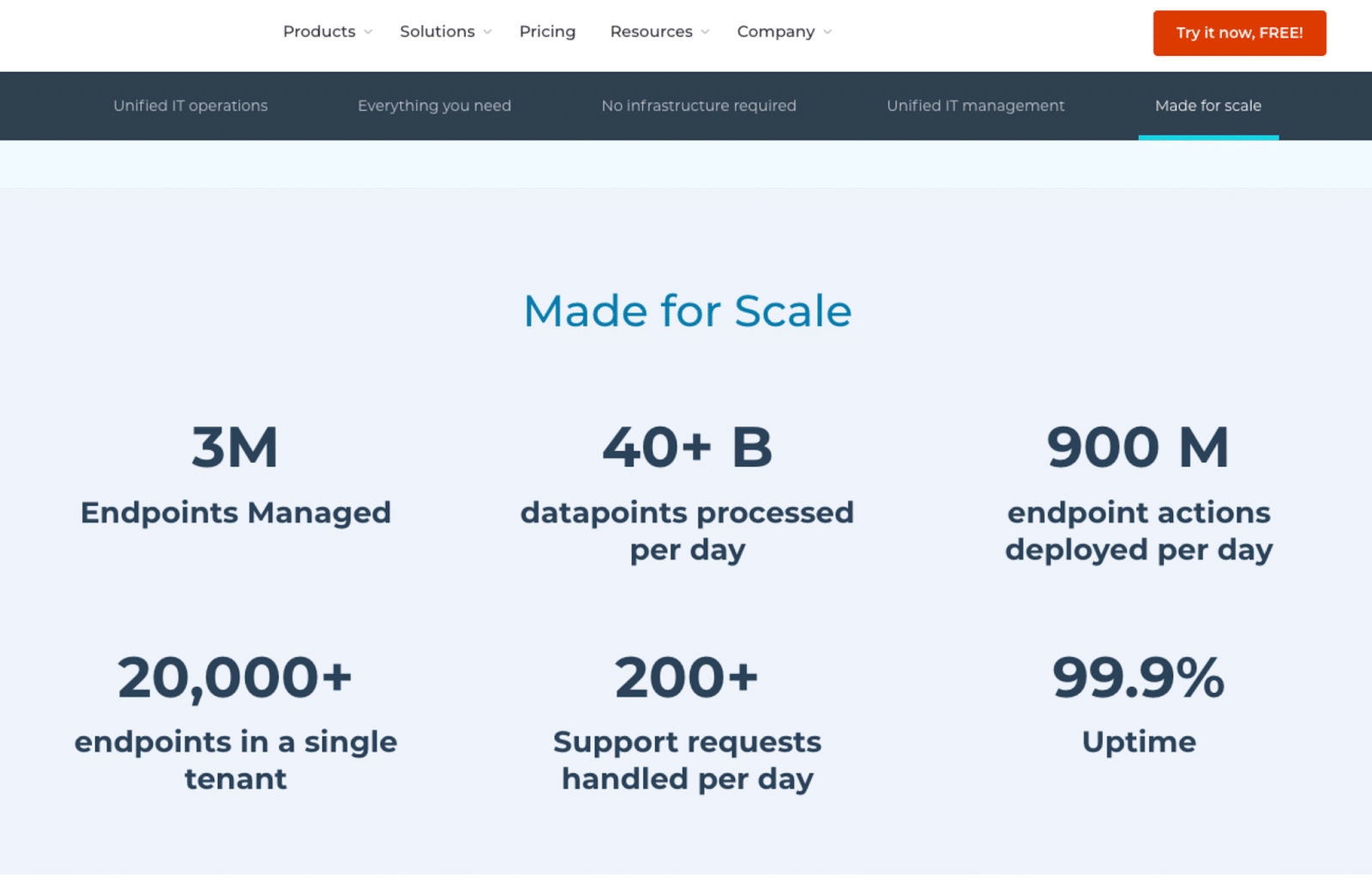
Larger customers often equal larger budgets. They tend to shop more for the product or service that will provide their customers or employees with the best experience.
Remember that large companies have longer sales cycles and have more decision-makers in their buying committees. This cycle requires more touchpoints and relevant content for users.
Sometimes, buying committee members enter the buying process very late and must be quickly brought up to speed.
It’s essential to have content ready for all departments, including finance, procurement, IT and more, to keep the deal moving and prevent any slowdowns.
Ad copy should address customer pain points and speak directly to the persona you’re trying to reach. For example:
- Trusted by over 250 Fortune 500 Companies
- 99.99% SLA Uptime
- Named G2 Top 50 Enterprise Products
- Enterprise-Grade Data Protection
Landing pages should be relevant to your search keywords and speak directly to your key persona. Consider creating landing pages for specific company sizes or job functions.
Get the daily newsletter search marketers rely on.
2. Differentiate audiences with keywords
Enterprise-level searchers won’t always identify their company size in their queries. That said, bidding on mid-market or enterprise-intent keywords can be beneficial (i.e., “enterprise software” and “tools for large companies”).
To eliminate budget waste on small businesses, consider adding “small business” as a negative keyword.
Think about what other keywords your buyer might be searching for, knowing that larger companies have different needs and concerns.
- Will they search for more security-focused terms?
- Will they search for more big-picture industry trends?
Competitive conquesting is another option for capturing the right audience.
When competitors have large companies as their key demographic, bidding on their keywords can help you capture some of their traffic or at least gain brand recognition via the SERP.
3. Couple offline conversion tracking with value-based bidding
Offline conversion tracking (OCT) is ideal for any B2B Google Ads account. It pushes your CRM data into the platform and allows for bidding optimizations on back-end leads, not just front-end website conversions.
But without telling Google the conversion values, Google will treat each lead equally and bid on them evenly. There are two ways to tell Google to optimize toward larger companies with OCT.
The first is to use dynamic values with OCT. Larger companies should have a larger value assigned to them in CRM. When used with a value-based bidding strategy like maximize conversion value or tROAS, the algorithm will prioritize the largest value leads first.
If you can’t get dynamic values with OCT, consider setting up separate conversion actions for each funnel stage by market segment. The setup might look like this:
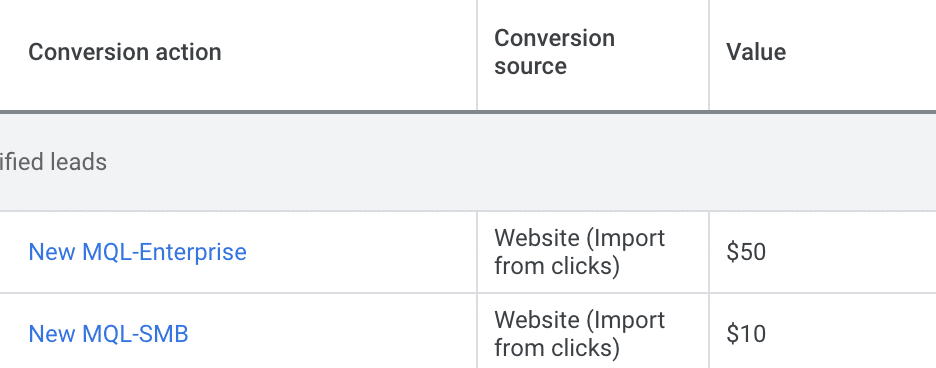
In the example above, a manual upload for OCT is used and knowing that the goal is to generate more enterprise-size leads, each lead is marked as either enterprise or SMB.
Enterprise MQLs get a value of $50, while SMB MQLs get a value of $10, telling the algorithm to prioritize enterprise MQLs.
4. Leverage first-party data
Your data is the most valuable data you can leverage in digital advertising as it is (hopefully) more reliable and accurate than third-party options.
Using first-party data to leverage conversion value rules with value-based bidding can take your campaigns to the next level.
According to Google:
“Conversion value rules allow you to provide additional value information that isn’t already reflected in your account (for example, different margins for different types of users, or lifetime value considerations) and optimize in real time to those values.”
Uploading a first-party list of prospects or customers within your ideal target can help you set a bidding adjustment for anyone on that list. The larger the list you provide, the better.
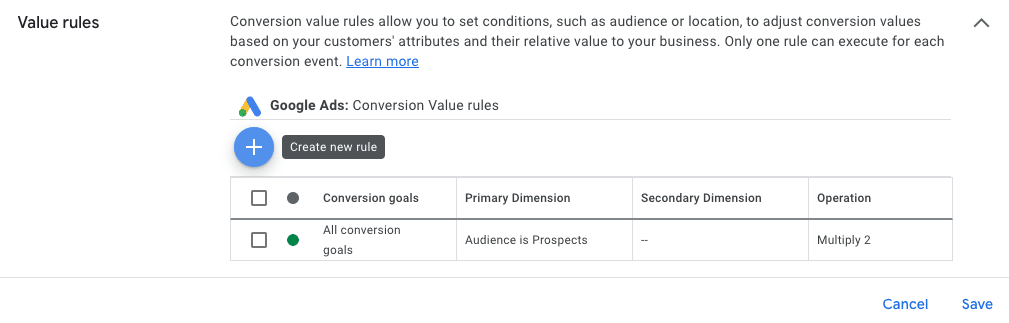
Conversion value rules, which can be set via campaign settings under “value rules,” can also be used with third-party data. If you know leads residing within a certain region or in-market for products/services are more valuable, you can also increase those audiences’ value.
With Microsoft Ads, bidding increases are available on specific company names, industries or job functions within your search campaigns.
This is helpful if you have an ABM strategy and a list of specific companies you want to target.
While manual bid adjustments only work with manual bidding strategies, Microsoft will use bid adjustments to inform decisions when on automated bidding strategies.

5. Assess the big picture
Leads aren’t everything. Sometimes it’s enough to know that you are reaching the right people and they’re clicking your ads, even if they need to warm up more to convert.
KPIs outside leads and cost per lead can help you understand if the needle is moving, especially with longer sales cycles and larger buying committees.
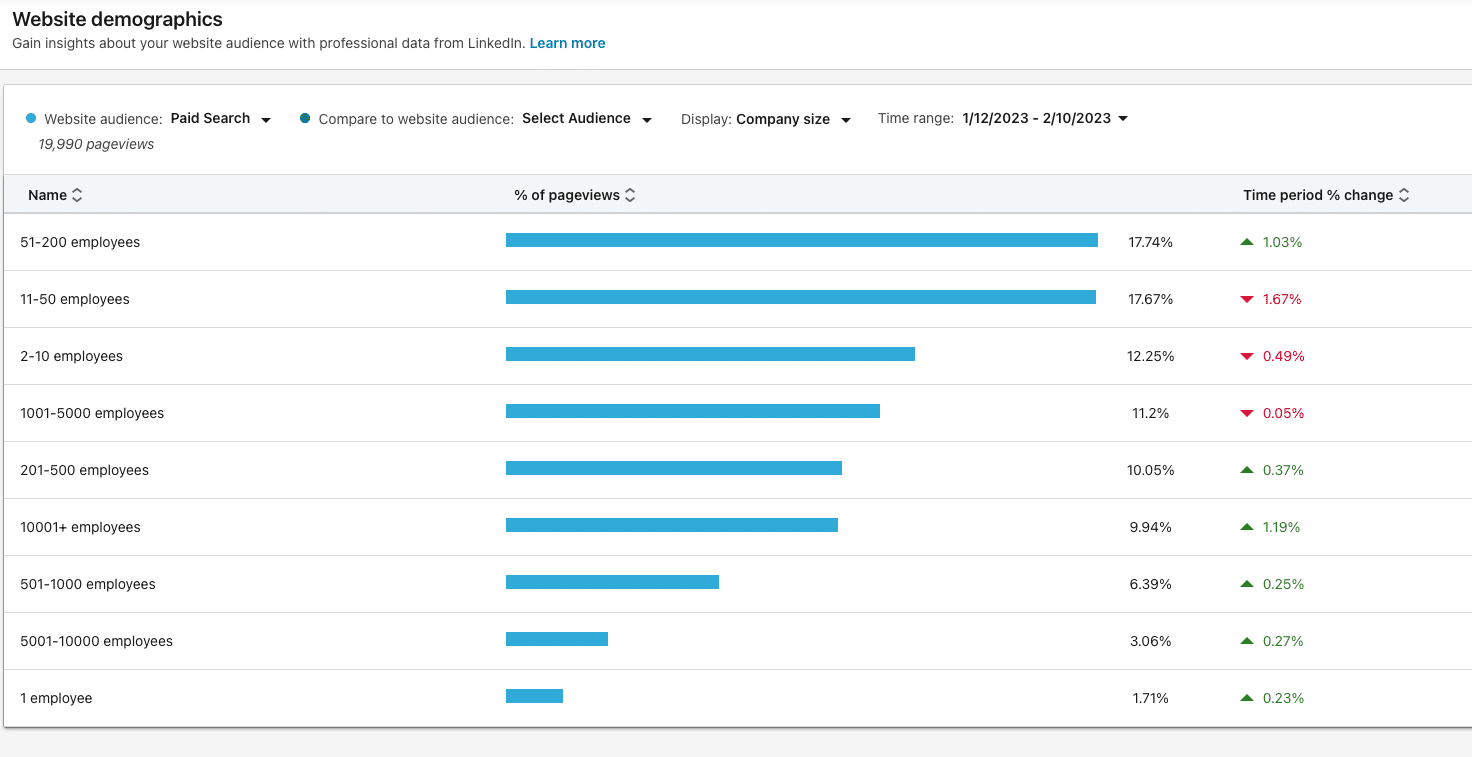
Look at LinkedIn demographics or Clearbit to know who’s visiting your site via ads.
In your LinkedIn ads account, build an audience based on specific website URL parameters that your audience would visit. For example, URL contains “google” and “paidsearch.”
Using the LinkedIn Website Demographics tool, you can glean insights into the companies, job titles, job functions and more that have interacted with your ads.
A tool like Clearbit integrates with Google Analytics to identify the companies, industries and job titles that visited your website. You can build audiences in GA with Clearbit data and push those audiences to Google Ads for targeting.
Consider building an audience of company sizes in your target range and launching a display, video or even RLSA campaign to those audiences. These audiences can also be used for conversion value rules to increase bids.
Reach your ideal B2B audience with better PPC ads
B2B search advertising can prove more challenging than B2C in some instances. But reaching the right audience is possible through content, tracking and measurement tactics.
A clear picture of your target persona and their pain points is crucial to eliminating budget waste. Step into your customer’s shoes and identify their job demographics, concerns, likes, dislikes and more to improve your messaging and nudge your strategy in the right direction.
Opinions expressed in this article are those of the guest author and not necessarily Search Engine Land. Staff authors are listed here.

Related stories
New on Search Engine Land
@media screen and (min-width: 800px) {
#div-gpt-ad-3191538-7 {
display: flex !important;
justify-content: center !important;
align-items: center !important;
min-width:770px;
min-height:260px;
}
}
@media screen and (min-width: 1279px) {
#div-gpt-ad-3191538-7 {
display: flex !important;
justify-content: center !important;
align-items: center !important;
min-width:800px!important;
min-height:440px!important;
}
}
About the author

Kerri Amodio is a Senior Digital Advertising Manager at Closed Loop. A specialist in B2B SaaS marketing, she became well-versed in executing digital advertising strategies across social, search and display while working in-house for B2B tech companies. Kerri has been on the agency side at Closed Loop for nearly four years, working with clients such as Slack, Netskope, Outreach, xMatters, Podium and Corporate Visions.

