Early in the 2000s, reciprocal link building was a popular method to increase your search traffic and boost your backlink profile.
Also referred to as “traded” or “exchanged” links, reciprocal links were something of an SEO hack – even though they were technically against Google’s guidelines.
These days, Google still says “no” to reciprocal links (they call it a “link scheme”).
But the web today is still full of them.
What gives?
The way reciprocal links appear on sites – and the way they occur – is different from 20 years ago.
Today, reciprocal links are a natural byproduct of owning a website.
It happens when you develop relationships with other sites through authentic outreach, not to mention when you link to sources without any expectation of reciprocation, but they discover your link and, in fact, organically reciprocate.
Further, an insightful link-building study done by Ahrefs shows how common reciprocal links still are on the web.
This graph shows that only 26.4% of the authority domains used in the study are not using reciprocal links:
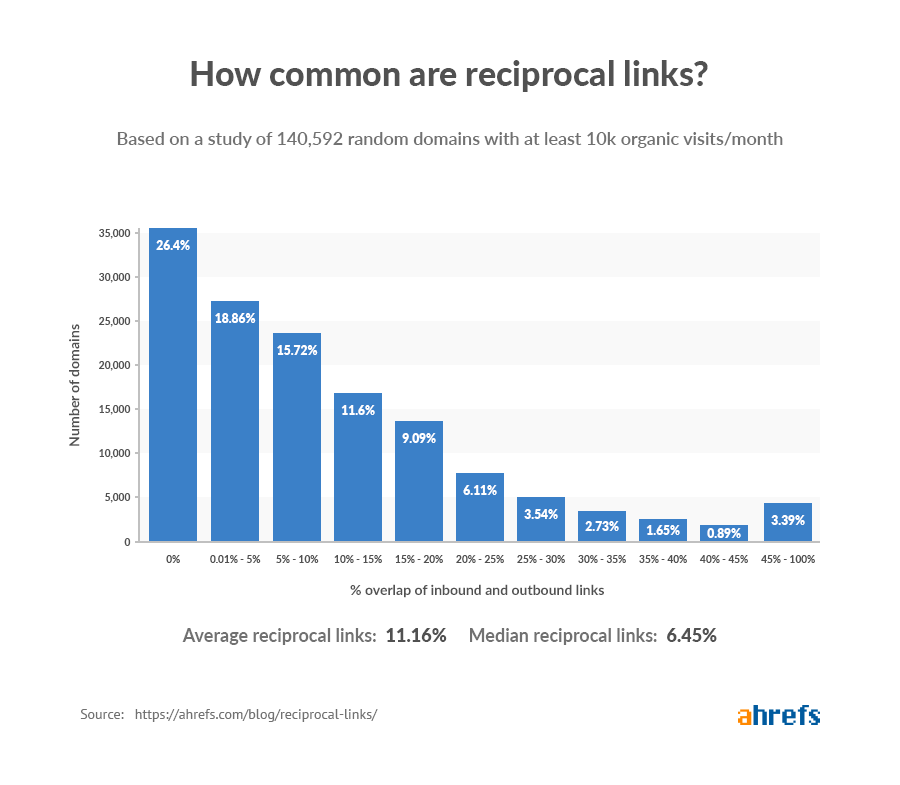 Screenshot from Ahrefs, August 2022
That means 73.6% of the domains are using them.
So, sure, reciprocal links are common, but do they help or hurt your SEO?
Intentions matter. Let me explain.
What Are Reciprocal Links?
A link exchange occurs when an agreement is made between two brands to trade links to boost SEO and site authority by essentially saying, “You link to me, and I’ll link to you.”
In essence, a reciprocal link is a quid pro quo or a “You scratch my back, I’ll scratch yours” situation.
Does this sound shady?
Maybe.
Is it shady?
It could be. That all depends on how – and how often – you use reciprocal links on your site.
Later in this article, we link to Ahrefs. The link sets us both up for a helpful, naturally occurring reciprocal link situation. Whether Ahrefs chooses to reciprocate by linking back to this article is entirely up to them.
If they do, that’s exactly how a natural reciprocal link is born.
Now, let’s take a look at the other end of the spectrum.
You might get emails or come across websites with shady link exchange offers. They’re usually pretty easy to spot:
- They offer an exchange or deal that will boost your SEO or help you rank in Google.
- They mention link networks or say the words “link exchange.”
- They talk about offering you multiple links or links on multiple sites.
Are Reciprocal Links Good For SEO?
If you want to grow your authority and rankings (and reduce the risk of penalties from search engines), the key is to focus on less risky strategies and tactics.
Above all else, your link-building methods should enhance your customer’s experience on your site.
Rather than focusing on SERP rankings and your website’s link profile, focus on providing something of value to your readers and customers by producing high-quality content.
Including some external links on your site can be helpful to SEO, but they aren’t the driving force behind your site’s ranking.
How To Use Reciprocal Links To Help Your SEO
Linking to quality sites that are relevant to your content enhances your reader’s overall experience on your website.
Content is king, and consistently delivering original and valuable information to your readers will earn your site a spot on the throne.
When you link to high-value content, you can establish your site as a trusted source of information.
In this case, if the other site reciprocates the link, consider it a bonus – the content matters first.
If you’re going to request reciprocation, check the site’s SEO metrics to ensure that you’re exchanging links with a high-authority website.
When reciprocal links occur naturally between authority sites, both sites may benefit.
Here are a few things to consider before you pursue a link exchange:
- Could the external site potentially improve your site’s traffic?
- Does the site produce content and share information related to your niche?
- Is the brand or business a direct competitor? (The answer to this one should be no!)
4 Ways Links Can Hurt Your SEO
There are some benefits to naturally occurring reciprocal links, but when you don’t use common sense, exchanging links can harm your site’s authority and rankings.
Here are four ways that links might actually hurt your SEO:
1. Site Penalization (Manual Action)
Simply put, reciprocal links are against Google’s Webmaster Guidelines.
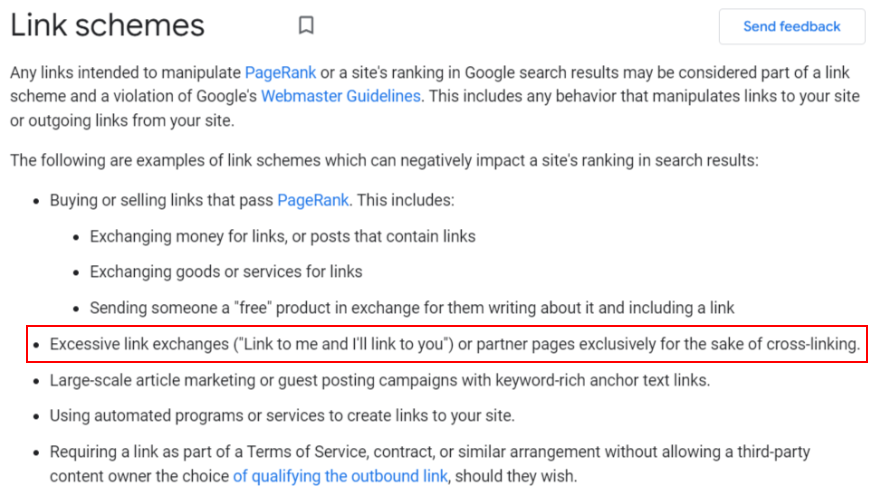 Screenshot from developers.google.com, August 2022
If your site is abusing backlinks – if you’re trying to manipulate search results by exchanging links – your website runs a high risk of being penalized by Google.
2. Decrease In Site Authority & Rankings
If you’re linking to external sites that aren’t relevant to your content, your page might experience a drop in site authority or SERP rankings.
Before linking, ensure that the content is relevant and check the site’s domain authority.
In some cases, it’s OK to link back to low-authority sites, but excessively linking to these sites will not improve your own website’s authority.
3. Boosting SEO For Direct Competition
When linking to sites with the same target keywords and phrases as your website, your chances of having that link reciprocated are low.
As a result, you’re only boosting your competition’s SEO, not your own.
Link exchanges or reciprocated links should be between sites with similar content and themes and not between directly competing sites.
4. Loss Of Trust
You never want to lose the trust of search engines. But reciprocal links can cause this to happen in two ways:
- Your site has a ridiculously high number of one-to-one links
- Your link’s anchor text is consistently suspicious or unrelated to your content.
Developing Relationships And Providing Value Are Key For Reciprocal Links
Don’t seek out reciprocal links for the sole purpose of getting more site traffic or building your backlink profile.
It won’t work, and you might get a Google penalty.
Instead, understand that aiming to be useful and valuable with your on-site linking will naturally lead to reciprocal links.
Linking to relevant, trusted resources is an excellent way to build authority and develop relationships with brands in your niche.
You’ll also give your readers immense value by pointing them to sites with trusted, relevant, useful content. That builds trust with your audience, which nurtures them and pulls them further into your brand ecosystem.
And that’s exactly what you want.
Featured Image: Paulo Bobita/Search Engine Journal